






Introduction
Small-scale manufacturers across the U.S. are under constant pressure to do more with less. Labour shortages, rising operational costs, and increasing demand for faster production cycles are forcing businesses to rethink their processes. Traditional automation has often been seen as too expensive or complex for smaller operations.
This is where Collaborative Robots for Manufacturing Businesses are changing the game. Unlike conventional industrial robots, cobots are designed to work alongside human operators, making automation more accessible, flexible, and cost-effective. For small manufacturers, this means the ability to scale production, improve quality, and stay competitive without massive capital investment.
As automation becomes more essential than optional, cobots are emerging as a practical entry point into modern industrial automation solutions.
What Are Collaborative Robots?
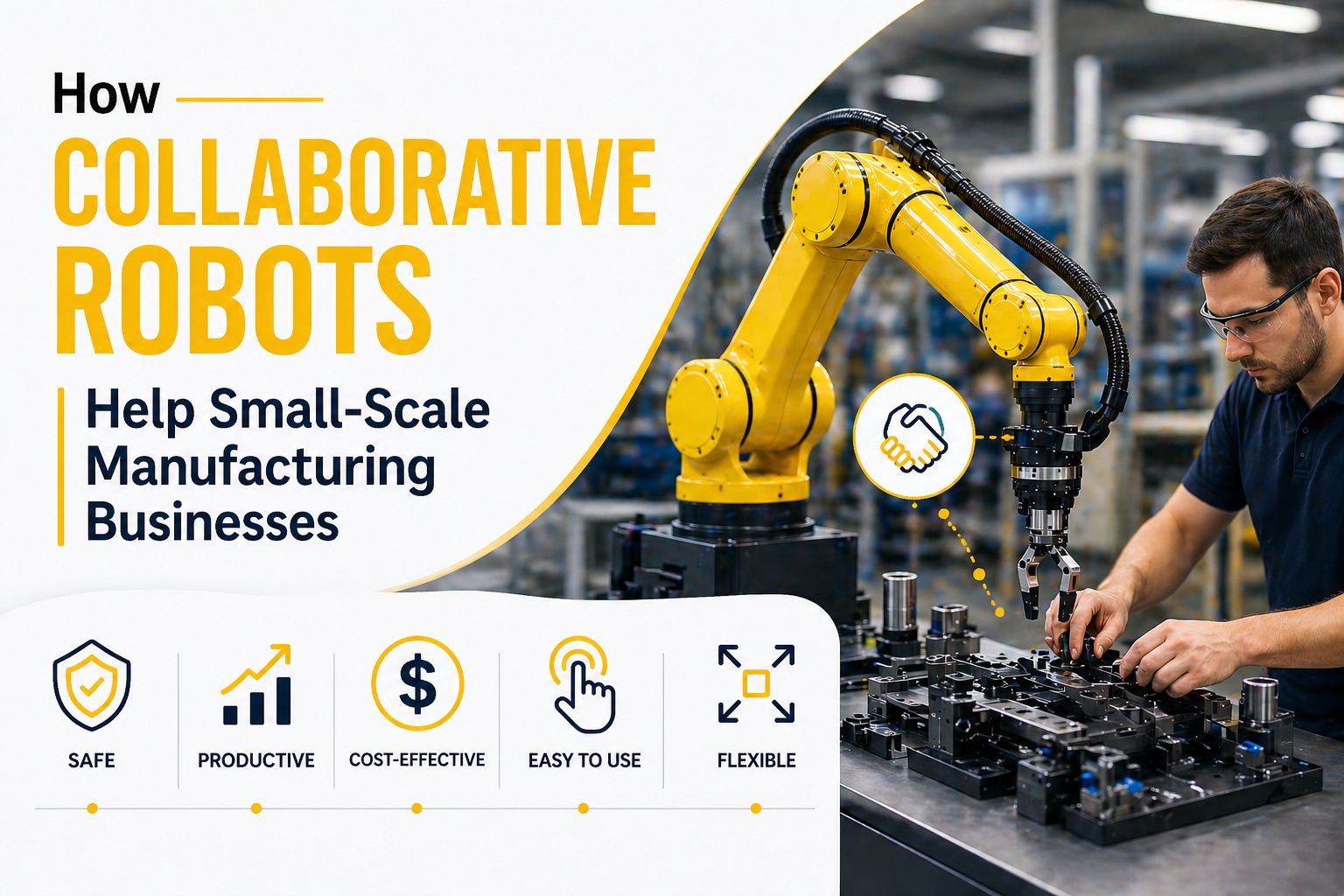
Collaborative Robots, often called cobots, are robots designed to safely interact with humans in a shared workspace. Unlike traditional robots that require safety cages, cobots can operate side by side with workers.
They are equipped with sensors, advanced control systems, and intuitive programming interfaces, allowing them to perform repetitive or precise tasks without replacing human involvement.
In the context of Collaborative Robots in Manufacturing, they act as assistants rather than replacements—enhancing productivity while keeping human expertise at the centre.
How Are Cobots Different from Traditional Industrial Robots?
The key differences between cobots and traditional robots come down to safety, flexibility, and cost.
Safety:
Cobots are built with force-limiting technology and collision detection, allowing them to stop instantly if they encounter resistance. This makes them suitable for shared workspaces.
Flexibility:
Traditional robots are often fixed in one place, performing a single task. Cobots, on the other hand, can be easily reprogrammed and redeployed for different applications.
Cost:
Cobots require lower upfront investment and minimal infrastructure changes. This makes Collaborative Robots for Manufacturing Businesses a viable option even for smaller operations with limited budgets.
Read More: How Robotic Bakery Systems are Solving the Labour Shortage
Why Are Cobots Well Suited for Small-Scale Manufacturing Businesses?
For small manufacturers, agility and cost control are critical. Cobots align perfectly with these needs.
Low Investment:
Cobots are significantly more affordable than traditional automation systems, making small manufacturing automation achievable.
Easy Deployment:
They can be installed quickly without major layout changes or complex engineering.
Space Efficiency:
Cobots have a compact footprint, making them ideal for facilities with limited floor space.
This is why collaborative robots in small-scale manufacturing are becoming increasingly common—they deliver high impact without requiring large-scale transformation.
What Types of Tasks Can Cobots Handle?
Cobots are versatile and can be deployed across multiple applications, including:
- Pick and Place: Handling repetitive material movement tasks
- Assembly: Assisting with precision assembly operations
- Machine Tending: Loading and unloading CNC machines
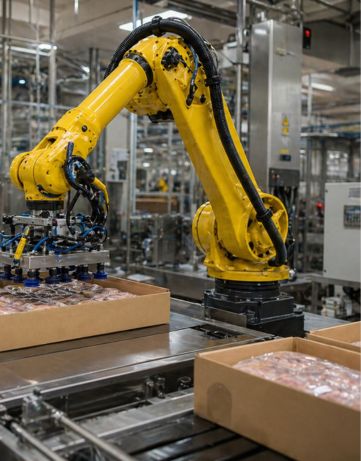
- Packaging: Streamlining packing and palletizing processes
- Inspection: Supporting quality control with consistent accuracy
These capabilities make cobots a strong fit for flexible automation systems, allowing businesses to adapt quickly to changing production demands.
How Fast Can You Expect a Return on Investment?
One of the biggest advantages of cobots is their fast ROI. Most small manufacturers can expect a return within 6 to 18 months.
Savings come from multiple areas:
- Reduced labour costs
- Increased production output
- Lower error rates and waste
- Improved uptime
When implemented correctly, Collaborative Robots for Manufacturing Businesses deliver measurable gains in efficiency and profitability. This makes them one of the most practical investments in modern industrial automation.
Are Cobots Safe to Use in Busy Environments?
Safety is one of the defining features of cobots. They are specifically designed for human-robot collaboration.
Key safety features include:
- Force and torque sensing
- Speed limitations
- Emergency stop mechanisms
- Advanced vision systems
These features allow cobots to operate safely even in dynamic environments where workers are constantly moving.
In Collaborative Robots in Manufacturing, safety is not an afterthought—it is built into the system design.
How Easy Are Cobots to Program and Manage?
Ease of use is another major advantage of cobots. Unlike traditional robots that require specialized programming skills, cobots are designed for accessibility.
- No-code or low-code interfaces allow operators to program tasks through simple drag-and-drop systems
- Hand-guiding features enable users to teach the robot by physically moving it
- Quick setup reduces downtime during deployment
This simplicity reduces dependency on highly specialized engineers and makes robot integration much more manageable for small teams.
What Holds Small Manufacturers Back from Adopting Cobots?
Despite the benefits, some manufacturers hesitate to adopt cobots. Common concerns include:
Cost Perception:
Many assume automation is too expensive, even though cobots are relatively affordable.
Lack of Knowledge:
Limited understanding of how cobots work or where they can be applied.
Integration Concerns:
Fear of disrupting existing workflows or facing technical challenges.
However, with the growth of collaborative robotics cobots industrial automation, these barriers are gradually being addressed through better education and support.
Why Partner with a Robotics Integrator?
Working with an experienced robotics integrator can significantly improve the success of your automation journey.
Expertise:
Integrators understand both the technology and manufacturing processes.
Custom Solutions:
They design systems tailored to your specific production needs.
Ongoing Support:
From installation to maintenance, they ensure smooth operation.
For companies exploring a Fanuc collaborative robot or other cobot solutions, having the right partner ensures proper implementation and long-term performance.
How Should You Evaluate Automation Integrators?
Choosing the right integrator is critical. Here’s what to look for:
Proven Experience:
Look for a track record in similar industries or applications.
Technical Capability:
Ensure they can handle end-to-end automation, from design to deployment.
Support Services:
Post-installation support and maintenance are essential for long-term success.
Industry Knowledge:
Understanding manufacturing workflows helps create more efficient solutions.
Selecting the right partner ensures your investment in Collaborative Robots for Manufacturing Businesses delivers maximum value.
Is Now the Right Time to Invest in Cobots?
The manufacturing landscape is evolving rapidly. Labour shortages are persistent, and customer expectations continue to rise.
At the same time, automation technology is becoming more affordable and accessible. Cobots are no longer a luxury—they are a strategic necessity.
Businesses that adopt Collaborative Robots for Manufacturing early gain a competitive advantage through increased efficiency, scalability, and consistency.
Delaying automation can mean falling behind competitors who are already optimizing their operations.
What’s the Next Step?
If you’re considering automation, the first step is understanding where cobots can deliver the most impact in your operations.
Start with an automation assessment. Identify repetitive, time-consuming tasks that can be streamlined. Evaluate your production bottlenecks and explore how cobots can address them.
With the right approach and partner like Robotco, Collaborative Robots for Manufacturing Businesses can transform your operations—helping you scale efficiently, reduce costs, and stay competitive in a demanding market.

1 comment on “How Collaborative Robots Help Small-Scale Manufacturing Businesses”
Pellentesque sollicitudin congue dolor non aliquam Morbi volutpat nisi vel ultricies urnacon dimentum sapien neque lobortis tortor, quis efficitur mi ipsum eu metus Praesent eleifend orci sit vehicula.