

Introduction
Retail businesses today are dealing with rising operational costs, long checkout queues, stock inaccuracies, and increasing customer expectations. Whether it’s a supermarket or a multi-location retail chain, maintaining efficiency while controlling expenses has become a constant challenge.
This is where the Retail Automation Robot is making a real difference. Retailers are now shifting toward smarter systems that reduce manual work and improve accuracy across operations. From inventory tracking to checkout processes, automation is transforming how stores function daily.
Instead of relying heavily on human intervention, retailers are adopting modern retail automation solutions to streamline operations, reduce errors, and improve customer satisfaction, all without significantly increasing overhead costs.
What Is Retail Automation and How Does It Work
Retail automation refers to the use of advanced technologies to handle repetitive and time-consuming store operations. This includes robotics, software systems, and smart tools designed to improve accuracy and efficiency.
At the core of this transformation are retail automation robots that assist in tasks such as shelf scanning, stock replenishment, and order processing. These systems work alongside existing store automation technology to create a seamless operational flow.
For example, a robot can scan shelves to identify out-of-stock items, while backend systems automatically trigger restocking processes. This integration between hardware and software defines modern robotic automation for retail, enabling faster and smarter decision-making.
Key Benefits of Retail Automation Robots
Implementing a Retail Automation Robot delivers measurable benefits across store operations:
- Cost Reduction
Automation reduces dependency on manual labour, helping businesses significantly lower operational expenses. - Labor Efficiency
Staff can focus on customer-facing tasks instead of repetitive activities like stock counting. - Accuracy Improvement
Automation minimises human errors in pricing, billing, and inventory tracking. - Faster Operations
Tasks like checkout, restocking, and reporting are completed much more quickly. - Better Customer Experience
Reduced waiting time and improved service quality lead to higher customer satisfaction.
These advantages make smart retail automation robots a strategic investment rather than just a technological upgrade.
How Retail Automation Reduces Operational Costs
Cost control is one of the biggest reasons retailers adopt automation. A Retail Automation Robot helps businesses cut costs in several practical ways.
First, labour savings are immediate. Repetitive tasks such as shelf monitoring and inventory checks are handled by machines, reducing the need for additional staff. This allows businesses to reallocate human resources to higher-value roles like customer service and sales.
Second, automation reduces errors. Pricing mistakes, stock mismatches, and manual entry errors often lead to revenue loss. With automation, these issues are significantly minimized, improving overall operational accuracy.
Third, inventory optimisation improves cash flow. Automated systems ensure that stock levels are maintained accurately, preventing overstocking or stockouts. This directly supports better inventory automation and smarter purchasing decisions.
Additional cost-saving factors include:
- Reduced shrinkage and losses
Automated monitoring systems help detect theft, misplaced items, and stock discrepancies early. - Lower training and onboarding costs
Automation reduces dependency on skilled labour for repetitive tasks, minimising training time and expenses. - Energy and resource efficiency
Smart systems optimize lighting, refrigeration, and equipment usage, helping reduce utility costs. - Faster process cycles
Automation speeds up operations like billing and restocking, increasing daily transaction capacity. - Data-driven decision making
Real-time analytics help retailers avoid unnecessary spending and improve operational planning.
Stat Insight: Retailers using automation systems report up to a 30% reduction in operational costs and a 25% improvement in process efficiency.
This makes automation one of the most effective ways to reduce retail costs while maintaining performance and scalability.
Inventory Automation: Smarter Stock Management
Inventory management is one of the most complex areas in retail. Manual tracking often leads to inconsistencies, delays, and lost sales opportunities.
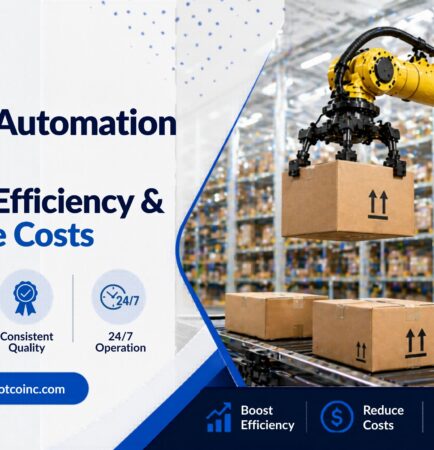
With modern retail robotics solutions, inventory automation becomes faster and more reliable. Robots can scan shelves in real time, detect missing products, and update inventory systems instantly.
This level of automation ensures:
- Real-time stock visibility
- Accurate demand forecasting
- Reduced stock discrepancies
By integrating a Retail Automation Robot, retailers can eliminate guesswork and maintain optimal stock levels, ultimately improving profitability.
Enhancing Customer Experience with Automation
Customer expectations have changed. Speed, accuracy, and convenience are now essential in retail environments.
Using automation robots in retail, businesses can significantly improve the shopping experience. Automated checkout systems reduce waiting times, while smart assistants help customers locate products quickly.
Additionally, automation allows staff to focus more on customer interaction rather than backend tasks. This creates a more engaging and personalized shopping experience.
A well-implemented Retail Automation Robot doesn’t just improve operations—it enhances how customers perceive the brand.
Backend Automation in Retail Operations
Retail success isn’t just about what happens on the shop floor. Backend operations play a crucial role in overall efficiency.
With robotic process automation in retail, businesses can automate:
- Sales and performance reporting
- Employee scheduling
- Data analysis and forecasting
These systems process large volumes of data quickly and accurately, helping managers make informed decisions.
When combined with Robotic Automation in Retail, businesses gain better control over operations while reducing administrative workload.
Real-World Use Cases of Retail Automation
Retail automation is already delivering results across different business formats:
Supermarkets
Automated shelf-scanning robots monitor inventory and ensure products are always available.
Retail Chains
Large retailers use centralized automation systems to manage multiple locations efficiently.
Warehousing + Retail
Integrated systems connect warehouses with retail outlets, enabling faster replenishment and order fulfilment.
These examples show how robots retail automation is not just theoretical—it’s actively improving retail operations today.
Why Retail Businesses Are Adopting Automation Fast
Retail is becoming more competitive, and businesses need to adapt quickly to survive.
Automation offers a clear advantage by improving efficiency, reducing costs, and enabling scalability. Whether it’s a single store or a multi-location chain, automation allows businesses to grow without proportionally increasing expenses.
The adoption of retail store automation robots is accelerating because retailers now see automation as a necessity, not a luxury.
Why Choose RobotCoinc for Retail Automation
RobotCoinc delivers advanced automation systems tailored for retail businesses. From system design to integration, the focus is on practical, results-driven solutions.
Their expertise in retail automation solutions ensures smooth deployment with minimal disruption to existing operations. Whether you’re implementing your first Retail Automation Robot or scaling automation across multiple locations, RobotCoinc provides reliable support.
With a strong focus on performance, flexibility, and long-term value, RobotCoinc helps retailers transition into modern, automated operations.
Future of Retail Automation
The future of retail is increasingly driven by intelligent automation. AI-powered systems, smart sensors, and robotics are shaping next-generation retail environments.
We can expect:
- Fully automated checkout systems
- Predictive inventory management
- Smart stores powered by real-time data
As automation robots in retail continue to evolve, businesses that adopt early will have a significant competitive edge.
Conclusion
Retail automation is no longer optional—it’s a strategic necessity. A Retail Automation Robot enables businesses to streamline operations, reduce costs, and improve customer experiences without major operational disruptions.
From inventory management to backend processes, automation delivers measurable results that directly impact profitability. For retailers looking to stay competitive, now is the right time to invest in smarter systems.
If you’re ready to transform your retail operations, explore RobotCoinc’s automation solutions or connect with their team to find the right fit for your business.
FAQs
What is a retail automation robot?
A retail automation robot is a system designed to perform tasks like inventory tracking, shelf scanning, and checkout assistance with minimal human intervention.
How much does retail automation cost?
Costs vary based on scale and requirements, but modern solutions are designed to be affordable and deliver quick ROI.
Is automation suitable for small retail stores?
Yes, many automation systems are scalable and ideal for small to mid-sized retail businesses.
What tasks can retail robots perform?
Retail robots can handle inventory management, customer assistance, checkout processes, reporting, and more.